
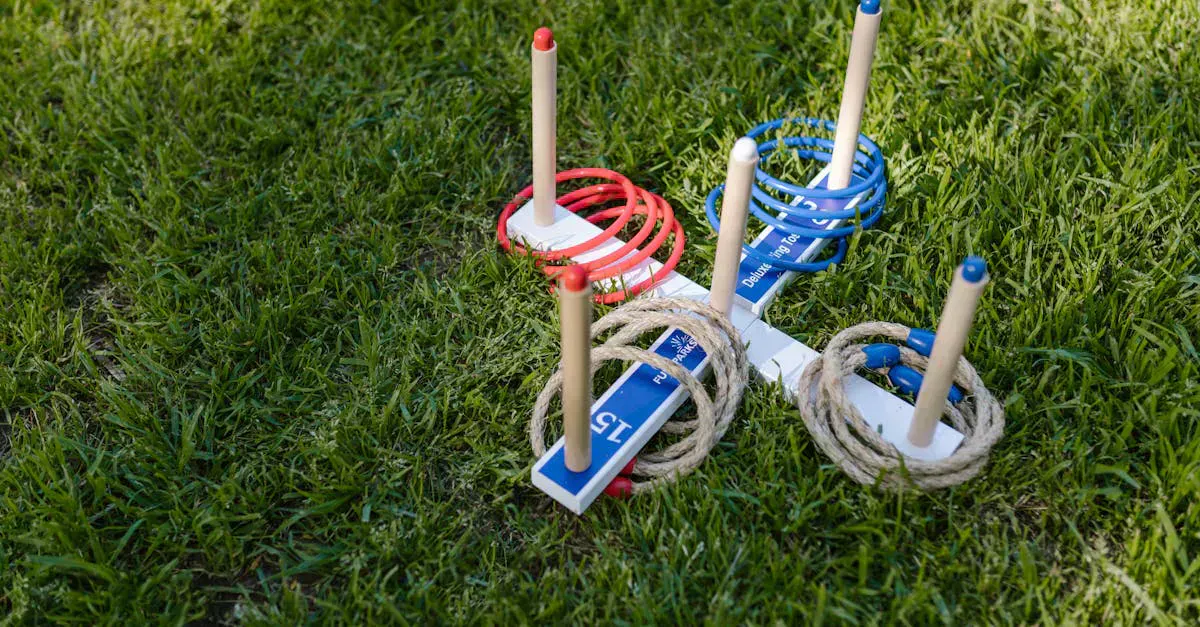
Hey! Play! Rope Ring Toss Game, 5 Rings and 5 Pegs
Researched pick; check the listing for current contents.
Guides Fall Festival Games and DIY Carnival Booths That Keep the Line Moving
the commissioner's booth planA good festival booth gives a kid a fair shot at something, fast, then sends them off grinning to the next table. Every booth here is built from a real lawn game, so you get sturdy gear, clear rules and a score sheet you can print tonight.
As an Amazon Associate, LawnLeagues earns from qualifying purchases made through links on this page. That never changes what you pay.
I sorted the booths from easiest to run to most involved. The first few need one volunteer and a prize bucket. The later ones want more room or older players. Each booth lists the space it takes, the ages it suits, a scoring rule you can explain in one sentence, and links to the full rules and printables.
The festival scoring below is a house version built for quick turns and prizes. When a booth turns into a real match, the rules pages have the standard scoring.
| Booth | Space | Ages | Volunteers |
|---|---|---|---|
| Ring toss | About 10 ft of toss room | 4+ | 1 |
| Bean bag toss | 15 to 20 ft for kids, about 35 ft for full cornhole | 5+ at the short line | 1 |
| Bucket toss | About 10 ft | All ages | 1 |
| Bowling pins | A flat lane, 8 to 20 ft | 5+ | 2 (one resets pins) |
| Giant games corner | A few square feet per game | 3+ | 1 |
| Ladder toss | About 15 to 25 ft | 8+ | 1 |
| Washer toss | About 15 to 20 ft | 8+ | 1 |
| Bottle bash | 20 ft between poles, plus room to catch | 12+ | 1 |
Start with the space you have and the number of volunteers you can count on. Each booth below lists a footprint. Add a few feet behind every target for stray throws and a queue lane in front, so the line does not spill into the walkway.
Point every throwing lane away from the main walkway and the food tables. Put the quiet booths, giant games and ring toss, near the entrance where little kids arrive first, and run the long lanes for bean bag toss, ladder toss and bottle bash along the edge of the field.
Decide the ticket rule once and use it everywhere: one ticket buys the same number of throws at every booth. It keeps the math simple for volunteers and fair for kids.
| Plan for | Rule of thumb |
|---|---|
| Volunteers | One per booth, two for bowling pins, since someone has to reset them |
| Throws per turn | Three is quick and fair; keep it the same at every booth |
| Throwing lines | Tape or chalk a kids' line and a grown-up line where a booth needs both |
| Prizes | A small prize for any score, a bigger one for a top score |
| Rain plan | Ring toss, bucket toss and the giant games move under a tent easily |
The easiest booth to run, and the one little kids understand before you finish explaining it. Set the pegs on flat ground, tape a line about 5 feet back for small kids and 8 to 10 feet for older ones, and hand over three rings.
Festival scoring: any ringer wins a small prize, and a ringer on the highest-value peg wins a bigger one. Ages 4 and up.
A cornhole board is the carnival bean bag toss with better bones. For a booth, one board is enough: players throw toward it from a short line, 15 to 20 feet for kids, and a volunteer tosses the bags back. Save the full 27 feet between two boards for a grown-up challenge at the end of the day.
Festival scoring: three bags, 1 point on the board and 3 in the hole. Score 3 or more for a prize. Ages 5 and up at the short line.
Giant yard pong buckets make a ready-made carnival bucket toss. Set a short row of buckets about 10 feet from the line, put the harder buckets at the back, and weight each one with a little water if it is breezy.
Festival scoring: three balls, any ball that stays in a bucket wins a prize, and the back row wins a bigger one. It works for all ages; move the line up for the smallest players.
Lawn skittles turn into a carnival bowling lane with almost no effort. Set the pins on a flat stretch of grass or pavement, mark a line 8 to 10 feet back for young kids and farther for older ones, and give each player three rolls.
Festival scoring: count the pins down across three rolls, and knock them all down for the top prize. This booth needs a pin setter, so plan on a second volunteer or a helpful older kid. Ages 5 and up.
A giant tumbling tower, giant four in a row and giant tic-tac-toe need almost no space and no throwing lane, which makes them the natural corner for younger kids and for families waiting on a friend.
Run them as challenges rather than ticket games: beat the volunteer at four in a row, get three in a row at tic-tac-toe, or pull a block without toppling the tower. A toppled giant tower takes a few minutes to restack, so give that game its own volunteer. Four in a row suits ages 4 and up, tic-tac-toe 3 and up, and the tower 8 and up, or younger with help.
Ladder toss is the booth older kids line up for, because the rungs make the score obvious from across the field. Set one ladder about 15 feet from the line for kids and farther for grown-ups, and hand over three bolas.
Festival scoring: 3 points for the top rung, 2 for the middle and 1 for the bottom, and 5 or more wins a prize. Keep the queue well clear of the ladder so nobody walks into a swinging bola. Ages 8 and up.
Washer toss plays in a shorter lane than cornhole and packs small, so it fits the tight spot between two tents. Metal washers are heavier than bean bags, so keep this booth for older kids and adults, with the queue off to the side.
Festival scoring: three washers, 3 points in the cup and 1 inside the box. Score 5 or more for a prize. Ages 8 and up.
Bottle bash, also called polish horseshoes, is the booth for the teens and parents who have outgrown ring toss. Two poles, a bottle on each and a flying disc: throw to knock the bottle off while the other side tries to catch both the disc and the bottle.
Set the poles 20 feet apart and play a short game to an agreed target, such as 11 points, so the line keeps moving. It needs room behind each pole for catching, so give it the edge of the field. Ages 12 and up.
Print one score sheet per booth and clip it to a board. It settles arguments, shows which booths are busiest, and gives you a record if you run a final showdown at the end of the day.
For the showdown, bean bag toss or ladder toss works best because the crowd can follow the score. Build the bracket ahead of time and post it where everyone can see it.
Fall festivals run into the early dark. If yours goes past sunset, glow rings and light-up targets keep the ring toss and bean bag booths going.
All free score sheets and rules cards
Free tournament bracket generator
If you would rather buy than build, these sets cover four booths and pack away for next year's festival.
Researched pick; check the listing for current contents.
Researched pick; check the listing for current contents.
Researched pick; check the listing for current contents.
Researched pick; check the listing for current contents.
Ring toss, bean bag toss, a bucket toss, bowling pins and a corner of giant games cover most ages with one volunteer each. Add ladder toss, washer toss and bottle bash for older kids and adults if you have the room. All of them are real lawn games, so the gear lasts well past one festival.
Start from a lawn game and change the scoring, not the equipment. Shorten the throwing line for kids, give every player the same number of throws, and pick a prize score everyone can see. If you want to build the gear too, cornhole boards, washer toss boxes, a giant tumbling tower and a bottle bash set are all weekend projects.
Ring toss, bucket toss and the giant games fit in about 10 feet. Bean bag toss for kids needs 15 to 20 feet, ladder toss about 15 to 25 feet, and bottle bash at least 20 feet between poles plus room to catch. Add a queue lane in front and a few feet behind each target.
Ring toss with the line moved close, giant tic-tac-toe and a bucket toss are the easiest wins for ages 3 to 5. Keep a short line, let every throw count for something, and keep little ones away from the metal washers and the bottle bash poles.
Use the same number of throws at every booth and a simple target: any ringer, three or more points, or every pin down. A small prize for any score and a bigger prize for the top score keep the line moving without a scoreboard argument. For a real match, use the full rules and a printed score sheet.