Cornhole Rules: Scoring, Distance & the Cancellation System
Cornhole is the king of the backyard for a reason: dead simple to learn, weirdly addictive, and perfect with a drink in your free hand. Here is everything you need to set up two boards and start tossing like a commissioner.
- 2 or 4 (1v1 or 2v2) PLAYERS
- AGES 8+
- 2 min SETUP
- About 35 ft long x 8 ft wide
What you need
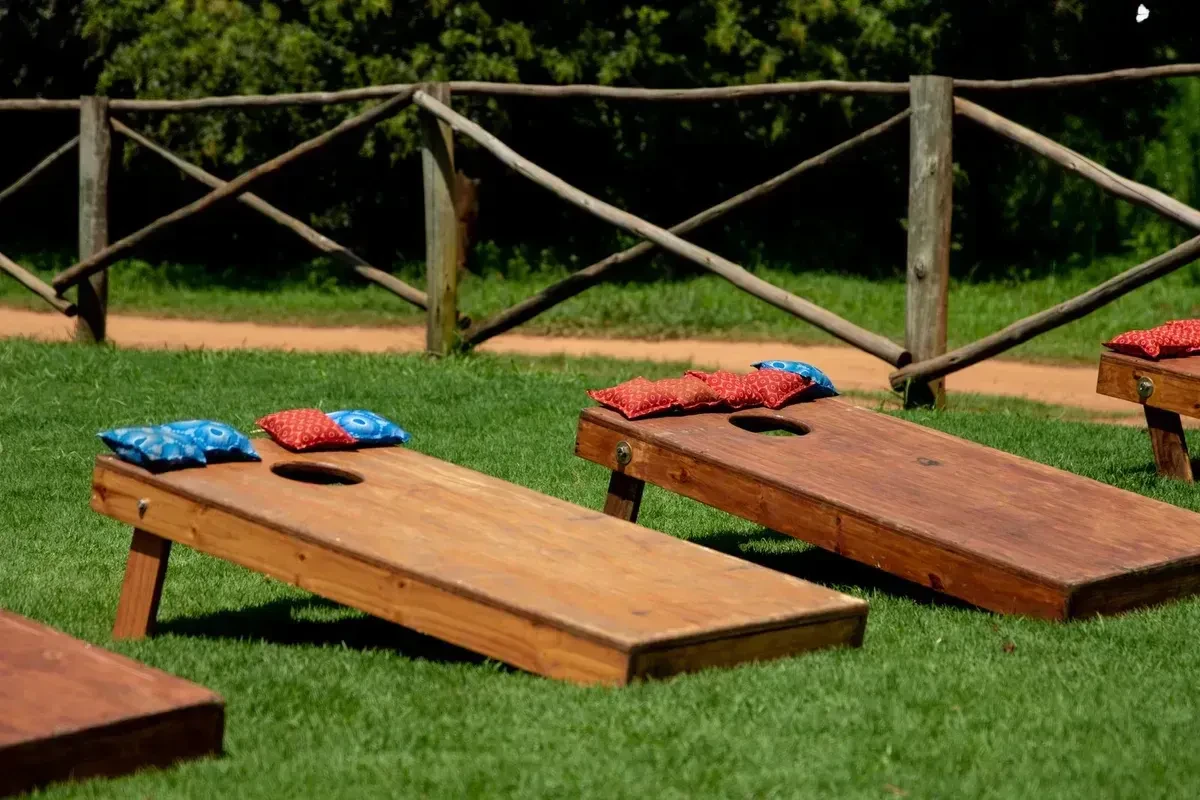
- 2 regulation cornhole boards (2 ft x 4 ft with a 6-inch hole)
- 8 bags total (4 per side, two colors)
- A flat lawn or driveway about 35 ft long: 27 ft between the boards, plus the two 4 ft boards themselves
- Optional: a tape measure to set the distance
How to play cornhole
- Set up the boardsPlace the two boards facing each other so the front edges are 27 feet apart. Players or teams split up, one at each board.
- Decide who throws firstFlip a coin or rally for it. The first frame's honors go to the winner; after that, whoever scored last throws first.
- Toss your bagsEach player throws their 4 bags one at a time at the far board, alternating with their opponent. Stay behind the front edge of your board (the foul line) when you release.
- Tally the frameOnce all 8 bags are thrown, count the points on the far board. That completes one frame (also called an inning or round).
- Switch ends and repeatPlayers at the far board now throw back the other direction. Keep playing frames until someone hits the winning score.
- Win the gameThe first team to reach 21 points (or more) at the end of a frame wins.
Scoring
- Bag through the hole = 3 points.
- Bag landing and staying on the board surface = 1 point.
- Bags that hit the ground first then slide on, or that fall off, score nothing. A bag touching the ground and resting against the board does not count.
- Cornhole uses cancellation scoring: in each frame the two sides' points cancel out, and only the higher side scores the difference. Example: you score 5, opponent scores 3, you net 2 points for that frame.
- First side to reach 21 at the end of a frame wins.
Cornhole court size & dimensions
The regulation cornhole court puts the two boards 27 feet apart, front edge to front edge. Here is the full setup, drawn to scale, with the board and hole measurements that matter.
| Regulation distance | 27 ft between front edges of the two boards |
|---|---|
| Board size | 2 ft wide by 4 ft long, raised 12 in at the back, 3 to 4 in at the front |
| Hole | 6 in diameter, centered 9 in down from the top edge and 12 in from each side |
| Bags | 6 in by 6 in, about 15 to 16 oz, 4 per player |
| Players | 2 (singles) or 4 (doubles) |
| Throwing line | Even with the front of each board (foul line) |
Regulation is 27 feet board to board, but for kids or a tight yard there is no shame in sliding the boards in to 15 to 20 feet so every toss has a real shot.
Fun variations
- Bust / wash-out house rule: some casual players require landing exactly on 21. Go over and you 'bust' back down to 15. Official ACL rules do NOT use this, you simply need 21 or more, but it is a popular backyard twist.
- Mini cornhole: smaller tabletop boards set about 8 to 10 feet apart, same scoring, great for indoors or kids.
- Play to 11 or 15 for faster games at a party.
- Move boards closer (15 to 20 ft) for younger kids.
Cornhole cancellation scoring, worked frame by frame
Cornhole scoring makes more sense when you separate raw points from the frame score. First count everything each side has after all the bags stop. A bag through the hole adds 3 raw points and a bag resting on the board adds 1. Then subtract the lower raw total from the higher raw total. Only the side with the difference adds anything to the game score.
That last subtraction is cancellation. It does not matter which individual bag cancels which. Three board bags do not have to be paired visually with one hole bag, and you do not remove a bag every time points match. Leave the board alone until the frame is complete, total both colors, and do one subtraction.
The three examples below use the same scoring rule in different shapes. Read the raw column first, then the cancellation column. That two-step habit ends almost every beginner scoring argument.
Frame 1: a hole and board bags beat one hole
| Side | Bags after the frame | Raw points | Points added |
|---|---|---|---|
| Blue | 1 in the hole, 2 on the board, 1 miss | 5 | 2 |
| Gold | 1 in the hole, 3 misses | 3 | 0 |
| Cancellation | Blue 5 minus Gold 3 | Difference of 2 | Blue adds 2 |
Frame 2: two holes erase a mixed frame
| Side | Bags after the frame | Raw points | Points added |
|---|---|---|---|
| Blue | 1 in the hole, 1 on the board, 2 misses | 4 | 0 |
| Gold | 2 in the hole, 2 misses | 6 | 2 |
| Cancellation | Gold 6 minus Blue 4 | Difference of 2 | Gold adds 2 |
Frame 3: equal raw totals wash out
| Side | Bags after the frame | Raw points | Points added |
|---|---|---|---|
| Blue | 1 in the hole, 1 on the board, 2 misses | 4 | 0 |
| Gold | 4 on the board | 4 | 0 |
| Cancellation | Blue 4 minus Gold 4 | Difference of 0 | Nobody scores |
Regulation cornhole versus backyard cornhole
Regulation framing is about consistency. The boards match, the foul lines match, every player releases from the same setup, and the group uses the standard cancellation system from the opening frame to the finish. That shared baseline matters when players practice in one yard and compete in another because the shot feels repeatable.
Backyard cornhole can flex to the lawn without pretending the adjustment is regulation. Move the boards only when the available space or the players require it, mark the agreed foul line at both ends, and keep the new setup fixed for the whole game. A closer throw should help both colors equally. It should not move after one side finds a rhythm.
The scoring does not change when the setup changes. A hole bag is still a hole bag, a board bag is still a board bag, ground contact still kills a bag, and cancellation still decides the frame. Keeping the scoring standard lets kids, first-timers, and experienced players share a game even when the throwing challenge is adjusted.
For every board measurement and throwing distance, use the dimension guide rather than a memory from somebody's last tailgate. It keeps the numbers in one place and gives you the diagram for checking which board edges define the lane.
The court size section above carries the court diagram, board measurements, and throwing distance. Use it whenever the setup needs to match regulation play.
The bust rule, exact-score games, and win-by variants
Standard cornhole has a straight finish: reach 21 or more at the end of a completed frame and the game is over. There is no penalty for passing the target. If a side begins the frame close to winning and earns more than it needs after cancellation, those points still produce the win.
The popular backyard bust rule changes that finish. Under the version already used in this rulebook, a team has to land on exactly 21. A frame that carries the team past 21 sends its game score back to 15. Cancellation still happens first, so nobody knows whether a bust occurred until both colors are totaled and the frame difference is clear.
Win-by-two is another optional finish. A side can reach the target and still have to build a lead of 2 before the match ends. That version creates a longer endgame when the teams trade small frames, so it fits a league night better than a party with a line waiting behind the boards.
Whatever finish you choose, say it before the first throw: straight target, exact target with a bust, shortened match, or target plus win-by-two. Changing the finish after a team gets close is not a house rule. It is moving the chalk line.
Doubles positioning, throwing order, and rotation
In doubles, partners begin at opposite boards. At each end, one player from each team stands beside the same board and throws toward the two partners waiting at the far end. Nobody has to walk the length of the lane after every toss, and each team always has a player ready to throw in either direction.
The two players at the active end alternate one bag at a time until both colors have thrown all 4 bags. The side with honors throws the first bag, the opponent answers, and the pattern continues. Do not let one player dump all 4 bags before the other color throws because that removes the shot-by-shot response that gives blockers and pushes their meaning.
After the frame is scored, the pair at the far board becomes the active pair and throws back. Partners do not trade ends in the middle of the game. The team that scored has honors; after a wash, the team that already had honors keeps it.
Cornhole glossary: airmail, blocker, hanger, dirty bag, hole-in, and push
Cornhole language mostly describes where a bag finishes or what job the throw was trying to do. You do not need the vocabulary to score a game, but it makes strategy much easier to explain between frames.
Common cornhole terms
| Term | Plain-English meaning |
|---|---|
| Airmail | A bag thrown directly through the hole without using the board for a slide |
| Blocker | A bag parked in front of the hole to make the opponent's direct path harder |
| Hanger | A bag resting at the lip of the hole without fully dropping through |
| Dirty bag | A dead bag that touched the ground before reaching the board |
| Hole-in | Any bag that finishes through the hole for 3 raw points |
| Push | A shot that slides another bag into a better position or through the hole |
Cornhole scoring edge cases before they become arguments
Judge every bag by where it legally finishes after the frame, not by how promising it looked in the air. A bag that touches the ground before coming to rest on the board is dead and scores nothing. A bag that slides off before the count also scores nothing. Remove a clearly dead bag so a later throw cannot push it into the scoring area.
A hanger still resting on the board is worth 1 raw point. If a later legal bag pushes it through the hole, it finishes as a hole-in and counts with the other hole bags when the frame is totaled. That is why players leave live bags in place until all throws are complete.
The front edge of the board is the foul line. A throw released after stepping past it is not a scoring bag. Call the foul when it happens, remove the bag, and continue the alternating order. Waiting until the frame ends makes the ruling feel like it depends on who won the subtraction.
Use the free cornhole score sheet to track each cancelled frame and the running game total without doing the whole match from memory.
Cornhole rules FAQ
How far apart are cornhole boards?
The front edges of the two boards sit 27 feet apart in regulation play. For kids or tight yards, move them in to 15 to 20 feet.
What happens if you go over 21 in cornhole?
In official ACL rules, nothing bad happens, you just need 21 or more to win. Many backyard players use a 'bust' house rule where going over 21 knocks you back to 15, but that is optional, not official.
How many points is a bag in the hole?
A bag through the hole is worth 3 points. A bag that lands and stays on the board surface is worth 1 point.
What is cancellation scoring?
Only one side scores per frame. You subtract the lower score from the higher one, and the leader banks the difference. If you net 5 and they net 3, you get 2 points that frame and they get zero.
Do you have to win by exactly 21?
No. Under official rules you just need to reach 21 or more at the end of a frame. The 'must land on 21 exactly' rule is a house variation, not the standard.
How many bags do you get?
Each player throws 4 bags per frame, so a 1v1 game has 8 bags in play and a 2v2 game splits 4 bags per team per side.
Can both teams score in the same cornhole frame?
No. Cancellation scoring allows only the side with the higher raw total to add the difference. If both colors finish with the same raw total, the frame is a wash and neither side adds to the game score.
Who throws first in the next cornhole round?
The team that scored the previous frame has honors and throws first. If the frame washed out, the team that already had honors keeps it for the next throw.
Where do partners stand in doubles cornhole?
Partners stand at opposite boards. One player from each team throws from the active end, alternating bags, then the two partners waiting at the far board throw the next frame back in the other direction.
Does a cornhole bag hanging over the hole count?
Yes, if the bag is still resting on the board when the frame ends, it counts as 1 raw point. If a later legal throw pushes that hanger through the hole before the frame is scored, it counts as a 3-point hole-in instead.
Does a cornhole bag count if it bounces off the ground?
No. A bag that touches the ground before reaching the board is a dirty bag and scores nothing, even if it bounces or slides onto the playing surface. Remove it so another throw cannot push it into a scoring position.
Ready to play?
Grab a set and start your league this weekend. We ranked the best cornhole sets for every budget.