GoSports regulation wooden cornhole set
Vetted by the commissioner and ready to play out of the box.
Guides Why Is Cornhole Called Cornhole? The Name, Explained
the name gameCornhole is called cornhole because the original bags were filled with dried whole-kernel corn, and the point of the game is to sink that bag of corn through the hole in the board. Bag of corn, hole in the board, cornhole. The name is that literal.
As an Amazon Associate, LawnLeagues earns from qualifying purchases made through links on this page. That never changes what you pay.
Of course, that is not the whole story, and it is definitely not why half the internet snickers when you say it. Here is where the name actually comes from, the legends people repeat about who invented the game, and how a farm-country pastime turned into a Cincinnati obsession with its own pro league on ESPN.
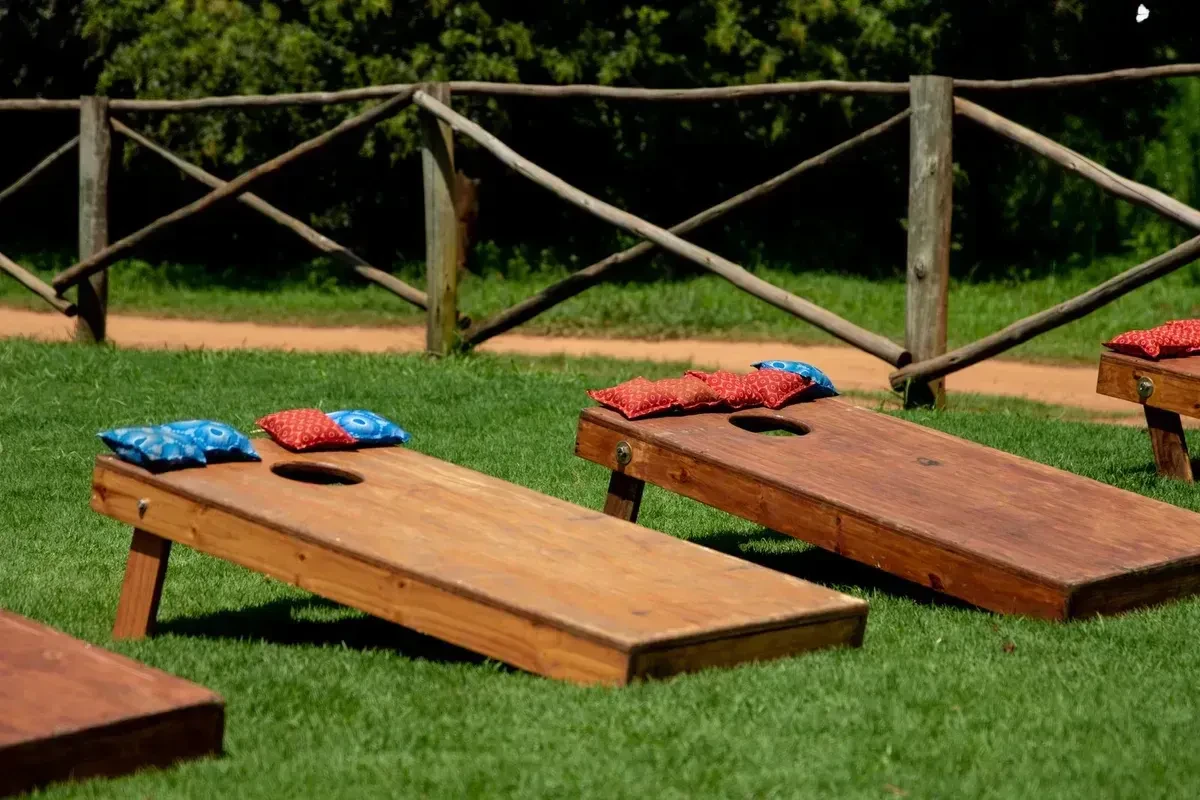
The game's two pieces of equipment name the game. Traditional bags are filled with about a pound of dried feed corn, and the raised board they get thrown at has a single 6 inch hole cut near the top. Dropping a bag through that hole is the best throw in the game, worth three points to a board-landing bag's one.
In the Midwest farm country where the modern game took root, the hole itself was simply the corn hole, the hole you put the corn through. Players talked about throwing corn and holing bags long before anyone printed an official rulebook. When the game needed a name, the name was already there.
The word has a crude slang meaning too, and every new player meets that joke within the first ten minutes of their first game. It is fair to wonder which meaning came first. The slang is old, but the game's name did not come from it. The game grew up in Ohio, Kentucky, and Indiana backyards where corn hole meant exactly what it said, and the name stuck because it described the game, not because anyone was being clever.
That collision is part of why some regions quietly renamed the game. Plenty of people in Chicago will only ever call it bags, and retailers love the safely generic bean bag toss. The game is the same. Only the blushing changes.
Ask around and you will hear two popular origin stories. One credits a 14th century German blacksmith who supposedly had farmers toss rocks at a hole in the ground, later swapping rocks for corn-filled sacks. The other credits a Kentucky farmer who watched kids throwing corn at a woodchuck hole and built a board to civilize the game. Both stories are told with great confidence, and neither comes with a shred of documentation.
Treat them as campfire history. Games where you throw something at a hole are about as old as people, and quoits, horseshoes, and bean bag games all fed into what became cornhole. The fun of the legends is that they both agree on the essentials: farm country, spare corn, and a hole that needed filling.
The documented ancestor most historians point to is an 1883 United States patent by Heyliger de Windt for a parlor game he called Parlor Quoits, a bean bag game with a slanted board and a square hole. It captured the core cornhole idea, throw a soft bag at an angled target and score for putting it through, decades before tailgates existed. Versions of it were sold as an indoor game in the late 1800s.
Nobody claims de Windt invented what you play at a cookout. His board had a square hole and the game faded from shelves. But it is the earliest clear record of the bag-through-a-hole formula on paper, which makes 1883 the closest thing the game has to a birth certificate.
The modern game exploded out of the Cincinnati area in the decades before smartphones, spreading through Ohio, Kentucky, and Indiana one cookout at a time. Cincinnati tailgates made the 2 foot by 4 foot board with a round hole the standard picture in everyone's head, and local leagues formalized the 27 foot distance and the cancellation scoring that make the game work.
From there it did what good backyard games do, it followed college football parking lots and family reunions across the country. By the time national organizations wrote official rulebooks, most of America had already played the Cincinnati version without knowing it.
What you call the game says where you learned it. Cornhole dominates in Ohio and Kentucky and is the name the professional organizations use. In Chicago and much of the upper Midwest the same game is simply bags. Baggo is technically a brand of portable set that became a generic name in parts of the South, the way Kleenex means tissue. Bean bag toss is the label you see on store shelves aimed at people who might blush at the real name.
| Name | Where you hear it | Same game? |
|---|---|---|
| Cornhole | Ohio, Kentucky, the pro leagues | Yes, the standard name |
| Bags | Chicago and the upper Midwest | Yes, identical |
| Baggo | The South, from a brand of portable set | Yes, often on lighter boards |
| Bean bag toss | Retail shelves everywhere | Yes, the generic label |
Backyard bags are still commonly filled with whole-kernel feed corn, which gives the game its name, its dusty smell, and that satisfying thwack. Corn has downsides though. It breaks down with play, sheds dust, attracts mice in the garage, and turns to mush if it gets rained on.
That is why serious and all-weather bags switched to plastic resin pellets. Resin fill holds a consistent weight, survives wet grass, and lets makers build dual-sided bags with a slick side and a grippy side. Regulation bags are 6 inches square and about a pound, whatever the filling. So the corn in cornhole is now optional, but the name is not going anywhere.
The game's organized era arrived when national bodies like the American Cornhole Organization and later the American Cornhole League standardized rules and started running televised tournaments. Pro cornhole broadcasts landed on ESPN networks, complete with slow-motion airmail replays and players with sponsorships, which is a strange and wonderful fate for a game named after a bag of corn.
The pro game runs on the same bones as your backyard setup, 27 feet between the boards, cancellation scoring to 21, and the same 6 inch hole. The only real difference is that the pros almost never miss the board.
If the history has you itching to throw, the setup is simple. Two boards 2 feet by 4 feet with the hole centered 9 inches from the top, front edges 27 feet apart, four bags per side, and cancellation scoring to 21. Our cornhole rules page walks every scoring case, and the regulation board size guide has the exact build measurements if you want to make your own.
One bag of corn through one hole, and you will understand why three states argue about who named it.
You cannot play the name origin. A regulation set turns the history lesson into an actual game night, and these are the boards and bags I would buy first.
Vetted by the commissioner and ready to play out of the box.
Vetted by the commissioner and ready to play out of the box.
Vetted by the commissioner and ready to play out of the box.
The name is literal. Traditional bags are filled with dried whole-kernel corn, and the goal of the game is to throw that bag of corn through the hole in the board. In the Midwest farm regions where the modern game grew up, the hole was simply called the corn hole, and the name transferred to the game itself.
The modern game took root around Cincinnati and spread through Ohio, Kentucky, and Indiana backyards and tailgates. The oldest documented ancestor is an 1883 patent by Heyliger de Windt for Parlor Quoits, a bean bag game with a slanted board and a square hole. Popular legends about a German blacksmith or a Kentucky farmer are told everywhere but documented nowhere.
No single inventor is documented. Heyliger de Windt patented the closest paper ancestor in 1883, a parlor bean bag game with an angled board and a hole. The game you recognize today, with a 2 by 4 foot board, a round hole, and boards 27 feet apart, was shaped by decades of backyard play around Cincinnati rather than by one person.
The bag-through-a-hole formula was patented as a parlor game in 1883, and versions were sold in the late 1800s. The modern outdoor game standardized around the Cincinnati area in the late 20th century, and national organizations wrote official rulebooks and launched televised leagues in the 2000s and 2010s.
Yes. Bags is what Chicago and much of the upper Midwest call the identical game, bean bag toss is the generic retail label, and baggo comes from a brand of portable set. Same boards, same four bags per side, same scoring. The name mostly tells you where somebody learned to play.
Many backyard bags still use dried feed corn, which is where the name comes from. Competitive and all-weather bags use plastic resin pellets instead because resin keeps a consistent weight, survives rain, and does not break down or attract mice. Regulation bags are 6 inches square and about one pound with either fill.
The word also has a crude slang meaning, so some regions and retailers prefer bags or bean bag toss. The game's name came from the corn-filled bag and the hole in the board, not from the slang, but the collision is why you see the same game sold under three different names.