
How to Play Petanque: Throwing, Scoring & the Cochonnet
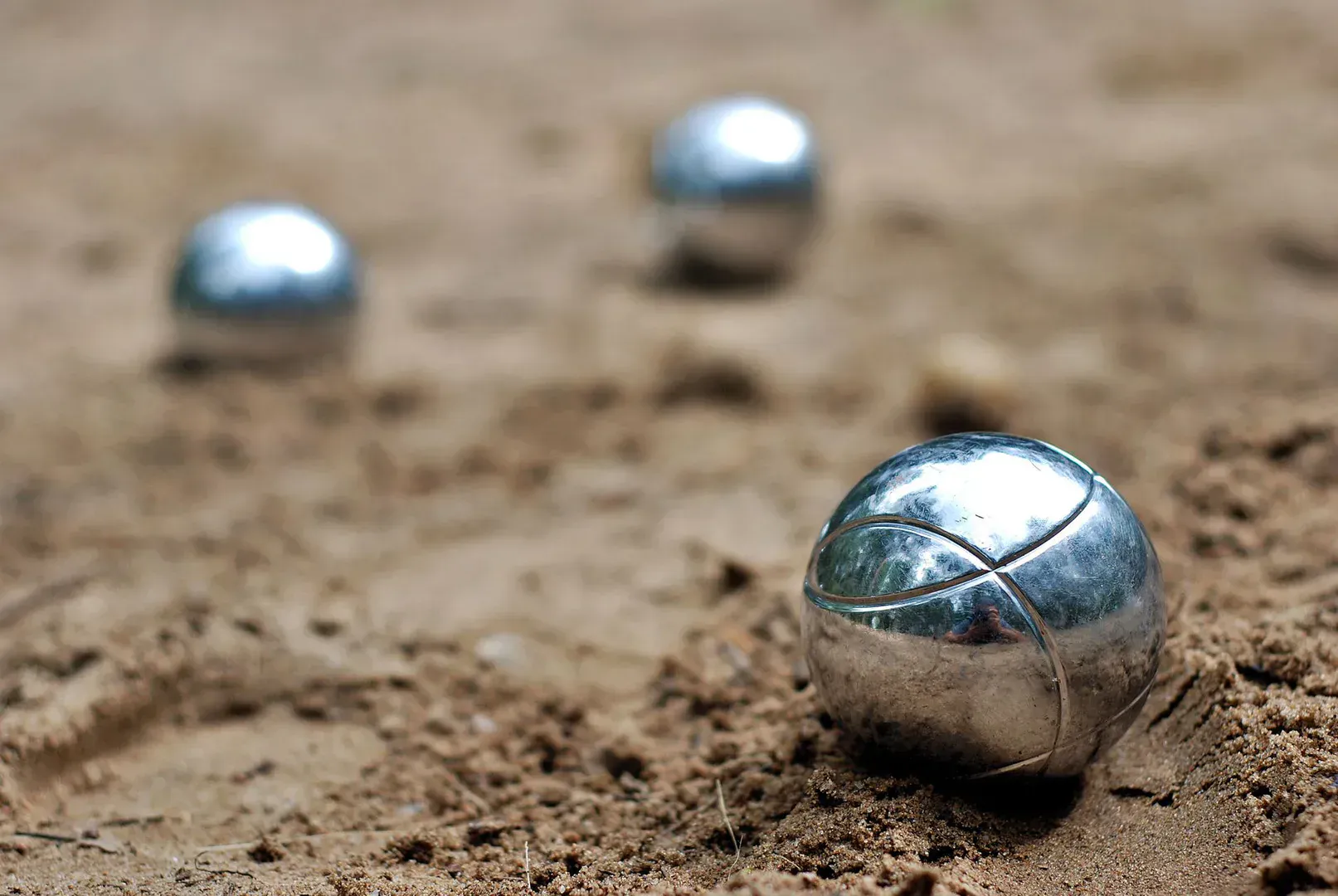
Petanque is the French cousin of bocce, played with small steel balls you throw rather than big balls you roll. The whole game happens from a fixed circle with your feet planted together, which is where the name comes from (pieds tanques, or feet together). You toss a little wooden target ball out, then try to land your boules closer to it than the other side. It is relaxed enough for a glass of wine and sharp enough to start arguments over a measuring tape. Here is how to set it up and score it like you mean it.
- 2 to 6 (1v1, 2v2, or 3v3) PLAYERS
- AGES 8+
- 1 min SETUP
- About 13 to 50 ft of flat ground
What you need
- Six steel boules total for singles; twelve for doubles or triples. Singles and doubles use three per player; triples use two per player.
- 1 cochonnet (the small wooden target ball, also called the jack or piglet)
- A patch of flat gravel, dirt, or short grass
- Optional: a circle to throw from (a hoop, chalk ring, or scratched line about 14 to 20 inches across)
- Optional: a tape measure for close calls
Need the gear? See our pétanque picks before game day.
How to play pétanque
- Choose the format and circleMake two sides: singles uses three boules per player, doubles uses three each, and triples uses two each. Use a throwing circle and choose the opening side before play.
- Throw the cochonnetA player from the first side stands in the circle with both feet on the ground and tosses the small cochonnet out to a spot roughly 20 to 33 feet away (about 6 to 10 m). It needs to land clear of obstacles and at least a foot and a half (about 50 cm) from any boundary.
- Throw the first bouleThe same side throws the first boule from inside the circle, feet together and flat, trying to land it as close to the cochonnet as possible. Your feet cannot leave the circle until the boule lands.
- The losing side throwsNow the side that is NOT closest to the cochonnet throws. They keep throwing until they get a boule closer than the other side, or run out of boules trying. Then the other side throws, and so on, always the side that is losing the point.
- Point or shootYou can lob a boule gently to sit near the cochonnet (pointing) or fire one flat and hard to blast an opponent's boule out of the way (shooting). Knocking the cochonnet to a new spot is fair game and a real tactic.
- Finish the end and scoreOnce every boule is thrown, measure and award points to the closest side. Then a player from the side that just scored draws a new circle around where the cochonnet ended up and throws it out to start the next end.
- Race to 13Keep playing ends and adding up scores. The first side to reach 13 points wins the game.
Scoring
- Only one side scores per end, the side with the boule closest to the cochonnet.
- That side earns 1 point for every boule that is closer to the cochonnet than the opponent's nearest boule.
- Singles has three boules per side and can score at most 3 in an end. Doubles and triples have six per side and can score at most 6.
- Games are played to 13 points. There is no win-by-two requirement, 13 ends it.
- If the closest opposing boules remain tied after every boule has been played, the whole end scores 0-0. Start the next end; do not discard the tied pair and count farther boules.
Keeping score on paper? Print the free pétanque score sheet. No signup needed.
Pétanque court size & dimensions
In pétanque you toss the jack 6 to 10 meters from a small throwing circle; a competition lane is 4 by 15 meters. Here is the layout to scale, with the boule and jack sizes.
| Throwing circle | 35 to 50 cm diameter; both feet stay inside it until the boule lands |
|---|---|
| Jack distance | Jack (cochonnet) thrown 6 to 10 m from the circle, at least 1 m off any obstacle |
| Competition lane | 4 m wide by 15 m long (marked terrain); casual play needs no lines |
| Boules | 70.5 to 80 mm steel boules, 650 to 800 g, 2 or 3 per player |
| Players | 1 vs 1, 2 vs 2, or 3 vs 3 |
Marked lanes are for tournaments. In the backyard you just need a circle, a thrown jack 6 to 10 meters out, and reasonably firm ground; gravel and packed dirt beat soft grass.
Fun variations
- Singles or doubles: 1v1 and 2v2 use 3 boules each; triples (3v3) use 2 boules each. Match the boule count to the format.
- Pointing vs shooting: lobbing a boule to nestle by the cochonnet is pointing; firing one to knock an opponent out is shooting. Good players do both.
- No-circle casual play: skip the throwing circle and just throw from behind a scratched line for a looser backyard game.
- Play to 11 for a faster game, or 21 for a longer one, agreed before you start.
Pétanque rules FAQ
What is the difference between petanque and bocce?
Petanque uses small steel balls that you throw through the air from a fixed circle with your feet together. Bocce uses larger balls that you roll along the ground and you can take a step. Petanque boules are also smaller and the target ball is the little wooden cochonnet rather than the pallino.
How do you score in petanque?
Only the closest side scores: one point per boule nearer the cochonnet than the opponent's nearest. The maximum is 3 in singles or 6 in doubles/triples. If the closest opposing boules remain tied after all have been played, the whole end scores 0-0.
What score do you play petanque to?
Games are played to 13 points. Unlike some games there is no win-by-two rule, the first side to reach 13 at the end of any end wins outright.
How far do you throw the cochonnet in petanque?
The little cochonnet is tossed out to roughly 20 to 33 feet from the throwing circle (about 6 to 10 m). It should land clear of obstacles and not right up against the boundary.
Do your feet have to stay together in petanque?
Yes. You throw from inside a small circle with both feet flat on the ground and together, and they cannot leave the circle until your boule has landed. That feet-together stance is literally where the name petanque comes from.
Can you knock the opponent's boule or the cochonnet?
Absolutely. Firing a boule flat and hard to blast an opponent's boule out of the way is called shooting, and knocking the cochonnet to a new spot is legal too. Both are core parts of petanque strategy.
Ready to play?
Grab a set and start your league this weekend. See the pétanque sets we picked and what comes in each box.