Setting Up a Backyard Pickleball Court: Dimensions and Net Guide
A pickleball court is 20 feet wide by 44 feet long, the same footprint as a doubles badminton court. The net sits 36 inches high at the posts and 34 inches in the center, and the non-volley zone, the kitchen, runs 7 feet back from the net on each side. Those few numbers are the whole court, and you can lay them out on a driveway, a patio, or a flat stretch of yard.
As an Amazon Associate, LawnLeagues earns from qualifying purchases made through links on this page. That never changes what you pay.
A pickleball court is 20 feet wide by 44 feet long, the same footprint as a doubles badminton court. The net sits 36 inches high at the posts and 34 inches in the center, and the non-volley zone, the kitchen, runs 7 feet back from the net on each side. Those few numbers are the whole court, and you can lay them out on a driveway, a patio, or a flat stretch of yard.
The cheapest way in is the driveway version. With a portable net, a tape measure, and some chalk or court tape, you can mark a real court for the price of a net and a roll of tape. Here are the dimensions, the lines, and every step in order.
Step by step
- Measure your space A full court is 20 by 44 feet of playing surface, and you want a little extra room around it, ideally 10 feet of clearance behind each baseline and a few feet on the sides so players are not running into a fence. Measure your driveway, patio, or yard before anything else. If you are a bit short on space, a backyard court still plays fine with less run-off room, you just lose a little chasing distance. cut listCourt = 20 x 44 ft. Aim for ~10 ft clearance behind each baseline and a few feet on the sides if you can.
- Lay out the outer rectangle Mark the four corners of the 20 by 44 foot rectangle. Measure carefully and check that the court is square by comparing the two diagonals, which should be equal when the corners are true. Stretch a tape or string along each side as a guide. Getting this outer box square first makes every line after it line up. cut listMark the 20 x 44 ft outer box. Verify square by matching the diagonals before marking anything else.
- Mark the kitchen and service lines Measure 7 feet back from the net line on each side and draw the non-volley zone line, the front of the kitchen. The centerline runs from each baseline up to the kitchen line, splitting the back court into two service boxes per side. There is no centerline through the kitchen. These interior lines are what make it pickleball and not just a rectangle. cut listKitchen line = 7 ft from the net each side. Centerline runs baseline to kitchen line, dividing the two service boxes. No centerline inside the kitchen.
- Apply the lines On a driveway or patio, lay down court tape or painters tape for lines you can peel up later, or use sidewalk chalk for a temporary court you redraw each time. On grass, use field-marking chalk or flat webbing line sets made for the purpose. Keep the lines a consistent width, around 2 inches, and press tape down firmly at the edges so a ball does not catch it. cut listDriveway: court tape or chalk. Grass: marking chalk or webbing lines. Lines ~2 in wide, pressed flat.
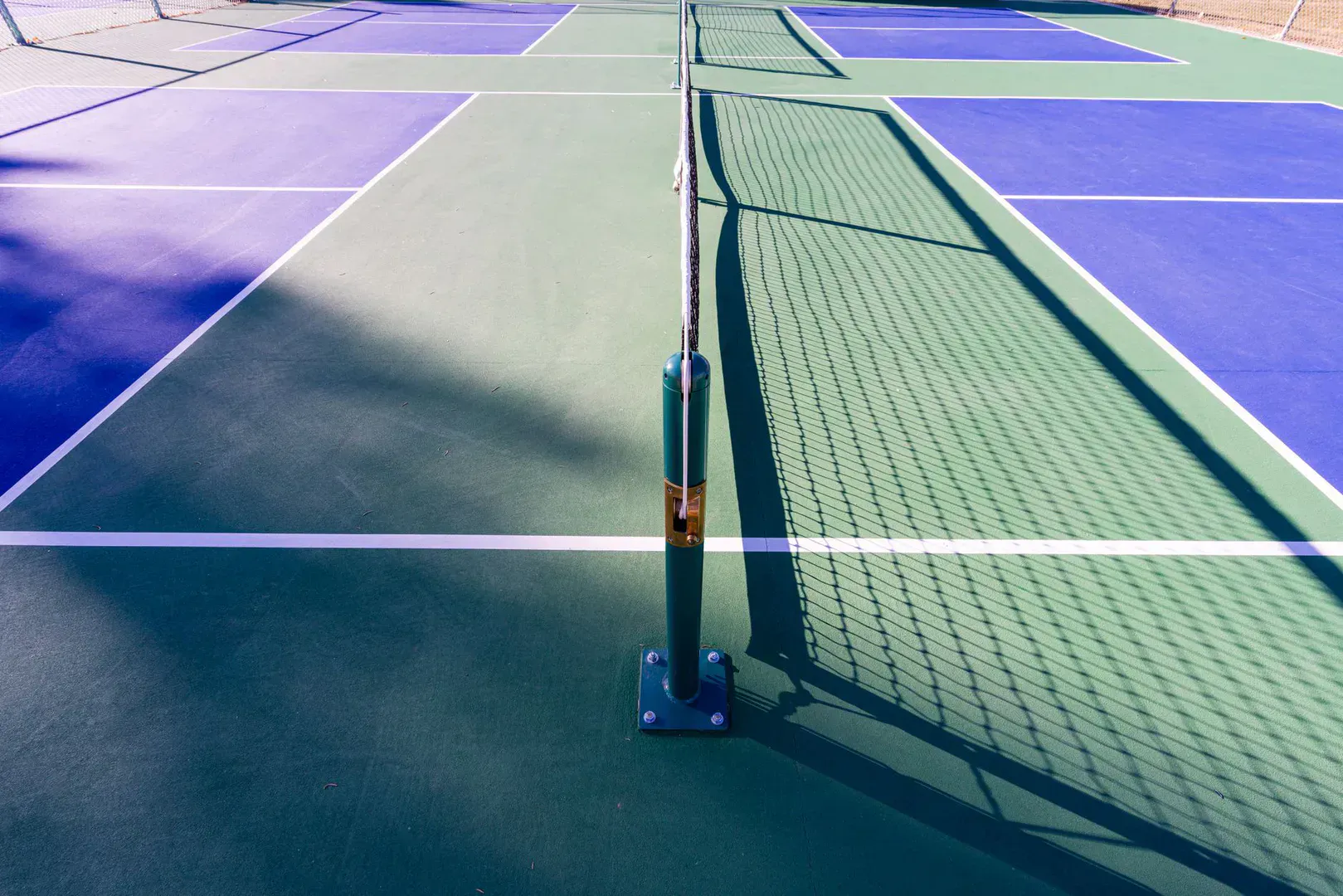
- Set up the net Place a portable pickleball net across the center of the court, 22 feet from each baseline. Set it 36 inches high at the posts and 34 inches at the center, since the standard net dips slightly in the middle. Most portable nets have a center strap or a built-in dip to hold that 34 inch center. Measure it with a tape rather than eyeballing it, because a net that is too high changes the whole game. cut listNet spans the center, 22 ft from each baseline. 36 in at posts, 34 in at center. Measure, do not eyeball.
- Grab paddles and outdoor balls You need a paddle per player and outdoor pickleballs, which are different from indoor balls. Outdoor balls are harder with smaller holes so they handle wind and rough surfaces, while indoor balls are softer with larger holes. A starter paddle-and-ball set covers a casual group. Add a couple of spare balls, because they crack eventually on hard surfaces. cut listOne paddle per player + OUTDOOR pickleballs (harder, smaller holes than indoor). Keep spares, they crack on pavement.
- Play a few points and adjust Hit some serves and dinks before you call it done. Check that the net height feels right, that the kitchen line is where you expect on a serve-and-volley, and that no tape edge is lifting. Tweak the lines or net tension as needed. A driveway court especially benefits from a quick test, since slope and surface change how the ball plays. cut listTest serve and dink, confirm net height and kitchen line, fix any lifting tape. Driveways play differently by slope and surface.
The driveway court on the cheap
You do not need a poured court to play real pickleball. The cheapest setup is a flat driveway, a portable net, and a roll of court tape or a stick of sidewalk chalk. That gets you a regulation-size court for not much more than the cost of the net itself, and you can erase or peel up the lines when you are done.
The two things that matter on a driveway are slope and surface. A slight slope is playable, you just pick a serving end and live with it, but a steep driveway gets frustrating. A rough surface chews through outdoor balls faster, so keep spares. Beyond that, a taped driveway court plays surprisingly close to the real thing, which is why it is how most backyard players start.
Net, paddles, and balls
Three pieces of gear get you playing: a net, paddles, and outdoor balls. A portable net is the heart of the setup, since it sets the 36 inch post and 34 inch center height and folds away when you are done. Look for one that stays taut and has a center support so it does not sag below 34 inches.
Paddles range from cheap starter wood and composite up to premium graphite and carbon-fiber faces. For a backyard, a starter paddle set is plenty to learn on, and you can upgrade once you know you love the game. For balls, buy outdoor pickleballs specifically. They are harder with smaller holes to cut through wind and survive pavement, where softer indoor balls would skip and wear out fast.
The gear to get playing
A net, a couple of paddles, and outdoor balls are all you need to turn a driveway into a court. These are the sets I would buy to get a backyard game going.
Niupipo pickleball set with net, paddles and balls
Vetted by the commissioner and ready to play out of the box.
GoSports portable regulation pickleball net
Vetted by the commissioner and ready to play out of the box.
JOOLA pickleball paddle set
Vetted by the commissioner and ready to play out of the box.
Setting Up a Backyard Pickleball Court FAQ
What are the dimensions of a pickleball court?
A pickleball court is 20 feet wide by 44 feet long, the same size for singles and doubles. The non-volley zone, called the kitchen, extends 7 feet back from the net on each side. That footprint is the same as a doubles badminton court, which is why some people line both on one surface.
How high is a pickleball net?
A pickleball net is 36 inches high at the posts and 34 inches high in the center, where it dips slightly. Set the center height with a tape measure rather than guessing, because a net that sags above 34 inches in the middle plays noticeably high all game. Most portable nets have a center strap to hold the dip.
Can you make a pickleball court on a driveway?
Yes, a flat driveway is one of the most popular backyard setups. You tape or chalk the 20 by 44 foot lines, set up a portable net, and play. Watch out for steep slopes, which make play frustrating, and rough surfaces, which wear out outdoor balls faster. Otherwise a driveway court plays close to the real thing.
What is the difference between indoor and outdoor pickleballs?
Outdoor pickleballs are harder with smaller, more numerous holes so they cut through wind and survive rough pavement. Indoor balls are softer with larger holes for a gym floor. For a backyard or driveway court, buy outdoor balls, and keep a few spares because they eventually crack on hard surfaces.
