
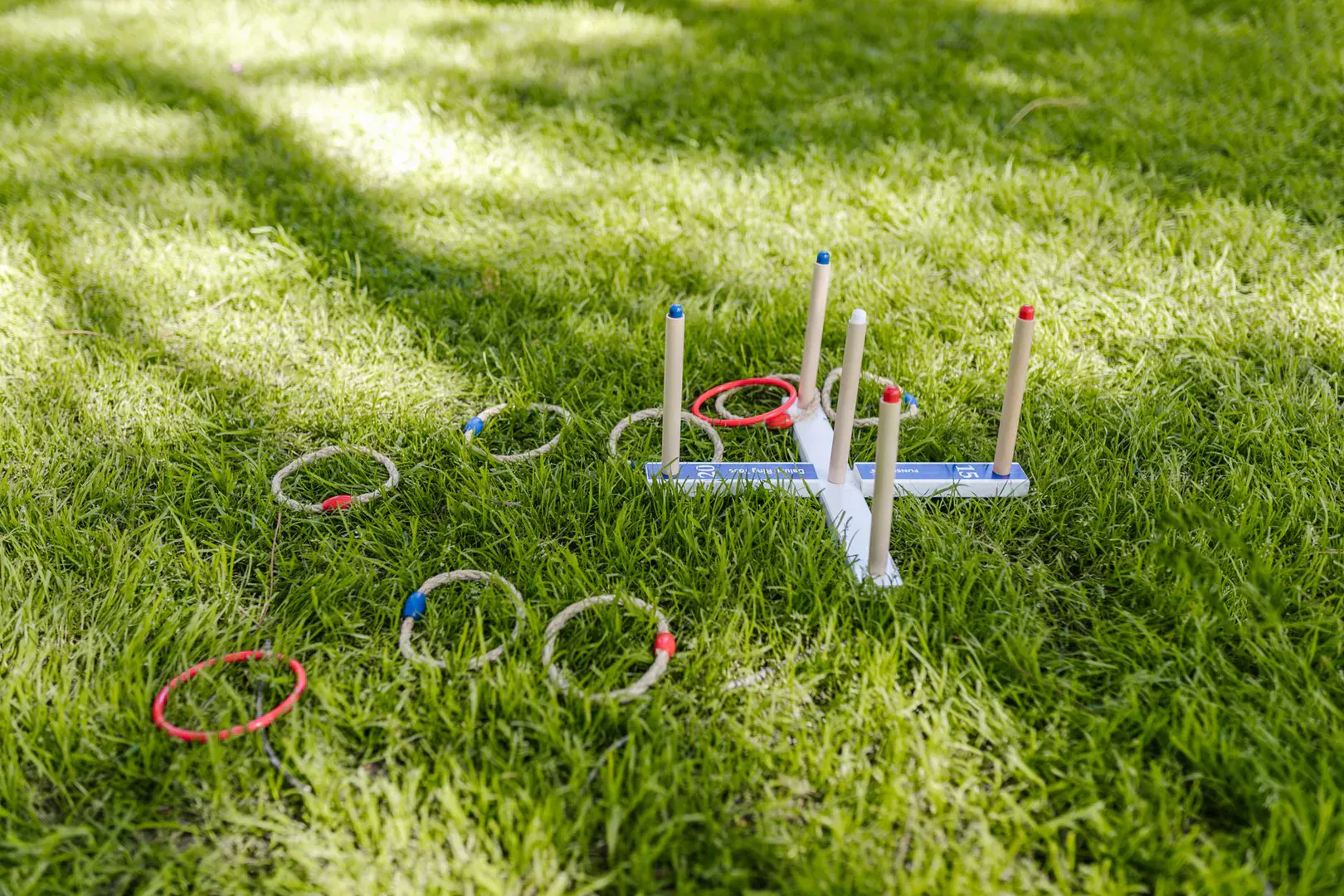
Garden Quoits Rules: Numbered Pegs & Scoring
This guide uses garden rope quoits with a wooden base and numbered pegs, as in Jaques garden sets. Toss a ring over a peg and add its printed value. Everyone gets equal throws, and you choose a target or round limit before starting. Metal-pit and slate-board quoits are separate games with different scoring.
- 2 or more, individually or in teams PLAYERS
- AGES 8+
- 2 to 10 min SETUP
- A clear tossing area sized to your garden set
What you need
- A garden quoits base with scoring pegs and the values visible
- The rope rings supplied with your set; the Jaques example has four
- A flat lawn, patio or other suitable level surface
- A marked throwing line and enough clear room for the set
- A scorecard for turn points and running totals
Need the gear? See our quoits picks before game day.
How to play quoits
- Place the peg basePut the garden base on level ground with every peg value visible. This version uses printed peg values, not metal-pit nearest-quoit scoring.
- Agree the finish and orderChoose a target score or a fixed number of complete rounds. Decide who starts and how many rings each player gets; use the same number for everyone.
- Take your turnThrow your rings from behind the agreed line, trying to leave each one encircling a peg. In the Jaques four-ring example, throw all four before scoring the turn.
- Add the peg valuesAdd the printed values of pegs encircled by your rings. Misses score zero. Record the turn points and your new running total; this garden version has no cancellation.
- Clear and rotateAfter agreeing the score, collect the rings for the next player. Complete the round so everyone has equal turns.
- Compare totalsAfter the agreed round limit, highest total wins. For a points target, finish equal turns before checking the result. In this garden house format, tied leaders play complete extra rounds until one leads.
Scoring
- Each quoit that lands and remains around a scoring peg earns the value printed on that peg or the base.
- Misses and rings merely leaning against a peg score zero in this garden version.
- Every player or side keeps its own turn points. Add them to the running total without cancellation.
- Agree a target or round limit before play and give everyone equal turns. With fixed rounds, highest total wins.
- This garden house finish uses complete extra rounds for a tie. Other quoits disciplines have different scoring and finish rules.
Keeping score on paper? Print the free quoits score sheet. No signup needed.
Quoits court size & dimensions
American quoits places the two hobs 21 feet apart, each centered in a square clay pit. Here is the pit layout drawn to scale, with the hob, the pit box, and the ring size.
| Regulation distance | 21 ft between hobs (American quoits); English long game runs 18 yd |
|---|---|
| Pit | About 3 ft square clay or soft ground box around each hob |
| Hob | Metal pin standing 2 to 3 in above the clay surface |
| Quoits | Metal rings, about 4 to 9 in across depending on the version |
| Players | 2 (singles) or 4 (doubles) |
Distances vary by tradition, from 18 yards in the English long game to 21 feet for American quoits. Pick one standard for your set, keep it consistent, and shorten it for kids.
Fun variations
- Team garden quoits: keep a fixed player order and combine each team's turn points.
- Unmarked peg sets: agree a peg-value system before play, rather than assuming the values for another set.
- Metal-pit and slate-board quoits use different equipment and their own rules; this garden card does not cover those disciplines.
- Family distance: agree a shorter throwing line before the first round when needed.
Quoits rules FAQ
What is the difference between quoits and horseshoes?
Garden quoits uses closed rope rings thrown over scoring pegs. Horseshoes uses U-shaped shoes pitched toward a stake and has its own cancellation rules. Metal-pit quoits is closer to horseshoes, but it is a different format from this numbered-peg garden game.
How do you score in quoits?
Score the printed value of every peg encircled by a ring. Misses score zero, and each player keeps their own points without cancellation. Agree a target or round limit, finish equal turns, and use complete extra rounds for a tie in this garden version.
How far apart do you stand in quoits?
Follow your garden peg set's instructions or agree a comfortable throwing line before play. There is no universal garden distance. Keep the line consistent; do not use a metal-pit or slate-board measurement as though it applies to every rope set.
What is a ringer in quoits?
A ringer is a quoit that encircles the peg. In this garden version it earns that peg's printed value, not a universal two-point score.
Is a leaner worth extra in quoits?
No. In this numbered-peg garden version, a ring must encircle the peg to score. A ring only leaning against it earns zero. Other quoits disciplines have their own leaner rules.
Can you play quoits without a clay bed?
Yes. The garden version uses a peg base and rope rings on a suitable level surface. It needs no clay or sand pit; those belong to other types of quoits.
Ready to play?
Grab a set and start your league this weekend. See the quoits sets we picked and what comes in each box.