
Spikeball Rules: Serving, the Pocket Rule & 2v2 Scoring
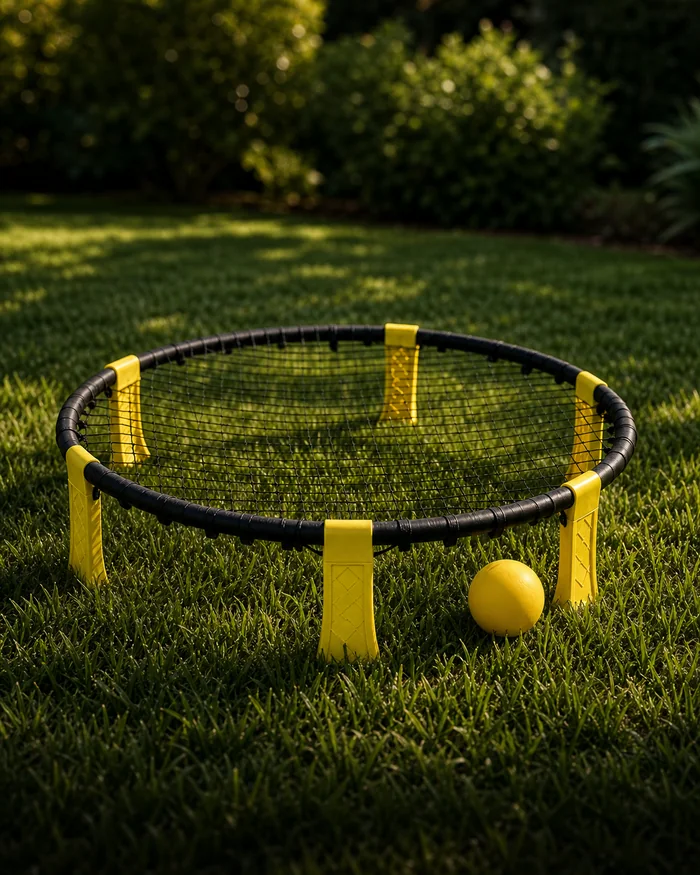
Spikeball (officially the sport of roundnet) is the high-energy 2v2 game played around a circular trampoline-style net at ankle height. It plays a bit like volleyball with no boundaries, so you can dive, sprint, and lay out anywhere. It looks chaotic, but the rules are tight and quick to learn. Here is how serving, the three-hit rule, faults, and scoring all fit together.
- 4 (2v2) PLAYERS
- AGES 10+
- Under 2 min SETUP
- About 30 ft circle of open space
What you need
- One Spikeball / roundnet set (the round net and frame)
- The small Spikeball ball
- Four players in two teams of two
- A flat open area with room to move 360 degrees around the net
- Grass, sand, or any soft surface for diving
Need the gear? See our spikeball picks before game day.
How to play spikeball
- Set up and start the serveSet up two teams of two around the net. All players except the receiver start at least 7 ft away. The designated receiver stands opposite the server. Choose a serving order for all four players and keep it throughout the game.
- Serve onto the netToss the ball, then strike it onto the net toward the receiver. A serve must rebound cleanly without a rim or pocket hit. A first service fault gets a second attempt; two faults give the receiving team a point.
- Use up to three touchesReturn the ball to the net within three team touches, normally alternating players. Soft-touch exception: if the ball hits a player while rising from the net, that player may touch it again; their partner must then return it to the net.
- Hit the ball back to the netOn the final touch, you spike or push the ball so it bounces cleanly off the net. There are no boundaries, so once it is off the net the rally is live and players can move anywhere around the net.
- Win the rallyA failed return, ground contact, direct rim hit or double bounce on the net ends the rally. The opponents score. A pocket or unusual net rebound is playable during a rally if it does not directly hit the rim.
- Play rally scoring to 21Every rally scores a point for the winning side, whether or not they served. Play to 21 and you must win by 2. The next serve goes to the team that won the rally.
Scoring
- Rally scoring: a point is awarded on every rally, served or not
- Games are typically played to 21 points, win by 2 (many casual games and tournaments also use 11 or 15, win by 2)
- You score when the opponents fail to return the ball to the net in 3 touches, let it hit the ground, miss the net, or commit a fault
- The team that wins the rally earns the point and serves next
- Keep the chosen serving order. A winning server switches places with their partner and serves again; when the receiving team wins, the next designated server takes over.
Keeping score on paper? Print the free spikeball score sheet. No signup needed.
Spikeball court size & dimensions
Spikeball has no rigid court; it centers on a 36 inch round net with the server standing about 7 feet back from the rim. Here is the setup to scale, with how the four players ring it.
| Court | No fixed boundary; the ball is live in any direction off the net |
|---|---|
| Net diameter | 36 in (about 3 ft) round, standing roughly 8 in off the ground |
| Serving distance | Server stays back, about 7 ft from the rim (7.5 ft from center) |
| Ball | 12 in circumference, inflated so it bounces about 20 in off the net |
| Players | 4 (2 vs 2); teammates start on opposite sides of the net |
There is no court to lay out, just open space all around the net, so leave 15 to 20 feet of clear room in every direction for diving rallies. Sand and grass both play great.
Fun variations
- Shorter games: play to 11 or 15 instead of 21, still win by two.
- Beginner setup: agree a closer serving distance while learning.
- King of the court: rotate teams between games so a larger group can take turns.
Spikeball rules FAQ
How many touches do you get in Spikeball?
A team has up to three touches, normally alternating teammates. If a ball rising from the net hits a player, the soft-touch exception lets that player touch it again; their partner must then send it onto the net.
How does serving work in Spikeball?
Everyone except the receiver starts at least 7 ft away. The server tosses and strikes the ball onto the net toward the receiver opposite them. A first fault gets a second attempt; two faults lose the point. Keep a fixed serving order.
What is the pocket rule in Spikeball?
A pocket is an unusual rebound near the edge of the net. Pockets are faults on serves but are playable during rallies when the ball does not directly hit the rim. A direct rim hit is a fault.
What score do you play to in Spikeball?
Spikeball uses rally scoring and games are commonly played to 21, win by 2. Many casual games and tournament rounds play to 11 or 15 instead, still winning by 2.
Are there boundaries in Spikeball?
No. Once the ball is served, there are no out-of-bounds lines. Players can move 360 degrees around the net to chase, pass, and dive, which is why you want a wide open area to play.
How does possession change in Spikeball?
A legal return onto the net sends possession to the opponents. The rally ends on a failed return, ground contact, direct rim hit or double net bounce. The rally winner scores and serves next; rally pockets remain playable.
Ready to play?
Grab a set and start your league this weekend. See the spikeball sets we picked and what comes in each box.