How to Play Disc Golf: Scoring, Discs & Beginner Rules
Disc golf is golf you play with flying discs instead of clubs and balls, and it might be the easiest big-yard sport to fall in love with. You throw a disc from a tee pad toward a metal basket, then keep throwing from wherever it lands until the disc clatters into the chains and drops in. The lowest total, including penalty throws, wins. Courses are usually free, the gear is cheap to start, and a beginner can learn the whole game in one round.
- 1 to 5 per group; play solo or in a foursome PLAYERS
- AGES 8+ (all ages can play casually)
- None on a real course; just show up and tee off SETUP
- A full course; holes often run 200 to 400+ ft each
What you need
- A driver for distance off the tee
- A mid-range disc for control and approach throws
- A putter for short, accurate tosses into the basket
- Comfortable shoes and a course to play (many city parks have free ones); a beginner 3-disc set covers all three needs
Need the gear? See our disc golf picks before game day.
How to play disc golf
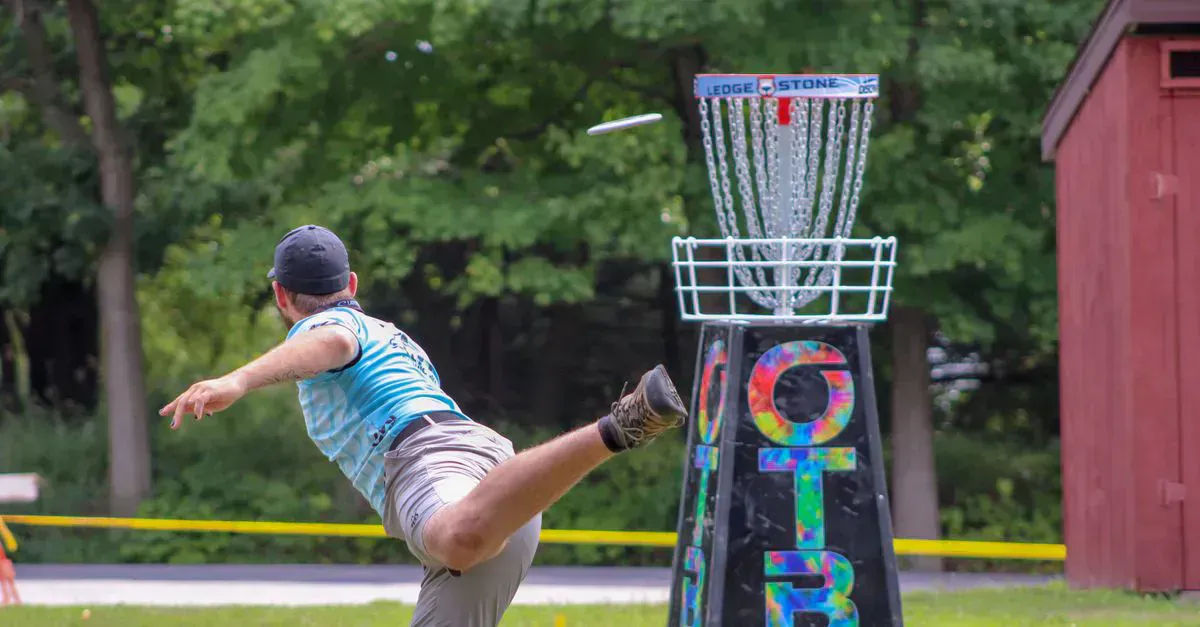
- Tee off from the tee padStart each hole by throwing your disc from the marked tee pad toward that hole's basket. Your first throw is your drive, usually with a driver disc for distance.
- Play from where it lands (your lie)Use the resting disc or a marker to establish your lie, then take your next throw from the legal position behind it. Follow the course rules for out-of-bounds areas and any marked drop zones.
- Keep throwing toward the basketTake throw after throw, choosing a mid-range or putter as you get closer for more control. Each throw should advance the disc nearer to the basket.
- Throw in order, farthest player firstIn a group, the player whose disc is farthest from the basket throws next. This keeps everyone safe and the round flowing in turn.
- Complete the hole in the basketThe hole ends when your disc comes to rest supported by the chains or basket tray. Record all throws for that hole, including any penalty throws.
- Move to the next teeAfter everyone finishes, move to the next tee. Add each hole score once for the 9- or 18-hole round total; penalty throws are already included in the hole scores.
Scoring
- Each hole score is the number of throws taken plus any penalty throws. Add each hole once for the round total.
- Par is a comparison with the expected score for a skilled player; being over par does not create an extra penalty.
- The lowest round total, including penalty throws, wins.
- Out of bounds adds one penalty throw. Normally play from the previous lie or within 1 m of the last in-bounds point; follow any course-designated options such as a drop zone.
- Common terms: a birdie is one under par on a hole, a bogey is one over par.
Keeping score on paper? Print the free disc golf score sheet. No signup needed.
Disc Golf court size & dimensions
A disc golf hole runs from a tee pad to a chain basket, typically 200 to 400 feet apart. Here is one hole drawn to scale, with the tee pad size and the basket dimensions.
| Hole length | 200 to 400 ft for most holes; beginner holes 150 to 240 ft, par-3 standard |
|---|---|
| Tee pad | Recommended 5 ft wide by at least 12 ft long, hard surface |
| Basket | About 26 in (66 cm) basket diameter, top rim roughly 2 ft 8 in off the ground |
| Course | Usually 9 or 18 holes; lowest total throws wins |
| Players | 1 to 4 or more per group |
Full courses live in parks, but a single backyard basket is plenty for practice. Set a tee spot and a basket as far apart as your yard allows, then add trees and angles as obstacles.
Fun variations
- 9 vs 18 holes: play a quick 9 for a casual outing or a full 18 for a complete round.
- Singles or groups: go solo to practice, or play in a group of up to four or five and throw in turn.
- Doubles (best disc): partner up and each play your own throw, then both throw again from the better-positioned disc.
- Casual backyard target: no course nearby? Pick a tree or a portable basket as your target and invent your own par.
Disc Golf rules FAQ
What discs do you need to start disc golf?
Beginners can start with just three discs: a driver for distance off the tee, a mid-range for control and approach shots, and a putter for short throws into the basket. Many brands sell a beginner 3-disc starter set that covers all three, which is the easiest and cheapest way to begin.
How do you score in disc golf?
For each hole, count your throws and add any penalty throws. Total the hole scores once for the round; do not add front-nine and back-nine subtotals again. The lowest total wins.
How do you play disc golf for beginners?
Throw from the tee toward the basket, then continue from each legal lie until the disc rests in the chains or basket tray. Record all throws, including penalties, for each hole. The lowest round total wins.
What is par in disc golf?
Par is the expected hole score for a skilled player. Compare your hole score, including penalties, with par: one below is a birdie and one above is a bogey. Par does not add or subtract throws from your actual total.
What happens if your disc goes out of bounds?
An out-of-bounds disc adds one penalty throw. The usual options are the previous lie or a lie within 1 m of where the disc was last in bounds. Course rules may specify alternatives such as a drop zone.
Ready to play?
Grab a set and start your league this weekend. See the disc golf sets we picked and what comes in each box.